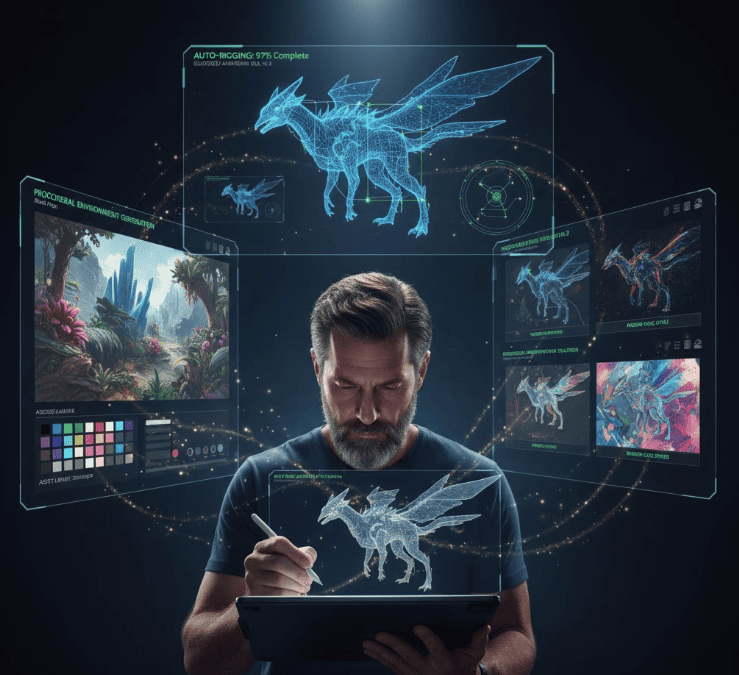
The Visual Effects (VFX) industry has never been more exciting or more demanding. Over the last decade, filmmakers, streaming giants, game studios, and advertisers have pushed for faster turnaround, higher quality, and more complex visuals. While traditional pipelines have evolved, today a new revolution is reshaping everything: Artificial Intelligence (AI).
AI is no longer a buzzword. It has become a core production tool, powering tasks that earlier required weeks of manual work. In many studios, AI is already reducing costs, accelerating workflows, and unlocking creative possibilities that were impossible before.
This blog explores every single detail about how AI is changing VFX: from pre-production to final comp.
1. AI in Concept Art & Pre-Production
● Faster Concept Art Generation
Tools like Midjourney, Stable Diffusion, DALL·E, and Adobe Firefly help artists create multiple visual ideas in minutes.
Instead of spending 8 hours on a rough concept, artists now generate dozens of variations instantly and refine them manually.
● Storyboarding with AI
AI helps convert text prompts into storyboard frames. Directors can visualize scenes long before production starts.
● Previs & Techvis Enhancement
AI-driven previs tools can automatically generate camera angles, lighting variations, and simple animation blocking.
This speeds up decision-making and reduces on-set confusion.
2. AI in 3D Modeling & Asset Creation
● Procedural AI-Based Modeling
AI tools can generate base meshes from simple sketches or text prompts.
Examples:
- Blender add-ons using ML
- NVIDIA’s AI-based mesh reconstruction
- Luma AI / Reality Capture for photogrammetry
● Auto-Retopology & UV Unwrapping
Earlier, retopo took hours. Now, AI-driven algorithms produce clean edge flow meshes, saving massive time.
● Material & Texture Generation
AI can create realistic textures, metals, skin, cloth, and decay by understanding reference images and generating seamless PBR maps.
3. AI in Animation
● Motion Capture Without Suits
AI-based “markerless mocap” tools like:
- Move.ai
- Wonder Dynamics
- Plask.ai
- DeepMotion
These allow animators to capture human movement using just cameras.
This makes professional-quality mocap accessible to small studios and freelancers.
● AI-Assisted Character Animation
AI predicts in between frames, improving smoothness and realism.
Animators still refine the motion, but the base work becomes faster.
● Facial Animation & Lip Sync
AI can auto-generate facial expressions and lip sync from audio tracks.
Example: Facegood Avatary, Speech to Face animation models.
4. AI in Simulation (FX)
AI-based solvers can predict physics faster than traditional simulation engines.
● Smoke, Fire, Water Simulation Optimization
AI-trained models generate fluid effects much faster and with less computing power.
This benefits Houdini workflows by reducing compute time.
● Cloth & Hair Simulation
Machine learning algorithms predict natural movement, reducing the need for repeated sim iterations.
5. AI in Compositing
This is the area where AI has made the biggest impact.
● Rotoscoping Automation
AI roto tools (like in Nuke, After Effects, Silhouette) can track edges and produce clean mattes almost instantly.
What earlier took 2 days now takes 2 hours.
● AI Keying & Matte Generation
AI can generate object mattes without a green screen by identifying foreground/background using deep learning.
● Cleanup & Plate Prep
AI helps remove wires, markers, rigs, people, and shadows faster and cleaner.
Tools like Content Aware Fill, Runway ML, Aviary, and CleanPlate AI models are becoming standard.
● Camera Tracking & Stabilization
AI can detect camera motion more accurately, giving cleaner tracks with fewer manual correction points.
6. AI in Rendering
● AI Denoising (Game-Changer)
Most modern render engines (Arnold, Redshift, Cycles, Octane) include AI denoisers.
This lets artists render fewer samples, saving hours per frame while maintaining quality.
● Upscaling & Frame Interpolation
AI improves resolution, adds details, and interpolates missing frames, making rendering cheaper and faster.
7. AI for Virtual Production
● Environment Generation
AI can create 360° HDR backgrounds for LED volumes instantly.
● Real-Time AI Optimization
AI helps adjust lighting, color correction, and reflections on the virtual sets in real time.
8. AI in Editing & Post-Production
AI helps in:
- Scene breakdown
- Automated rough cuts
- Color correction suggestions
- Audio cleanup
- Dialogue enhancement
- Shot matching across sequences
Editing becomes smoother and faster, especially for OTT and advertising workflows.
9. Impact of AI on VFX Jobs
This is the most talked-about section.
● AI is Not Replacing Artists, It’s Enhancing Them
AI does repetitive tasks, but creativity still belongs to humans.
Studios still need:
- Compositors
- FX artists
- Lighters
- Modelers
- Animators
- Supervisors
- VFX producers
● New Roles Emerging
AI pipeline TD
AI asset QC artist
AI data trainer
AI previs specialist
● Freelancers Get More Power
Small teams can now produce shots that earlier required big studios.
10. Challenges of Using AI in VFX
Not everything is perfect.
● Ethical issues
Deepfakes, AI cloning, and copyright concerns exist.
● AI outputs need cleanup
AI rarely gives final quality results.
Artists must refine, fix, and polish.
● Data privacy
Studios must protect production assets while using cloud-based AI tools.
● Style consistency
AI sometimes produces inconsistent imagery across sequences.
11. Future of AI in VFX
The next 5 years will bring:
- Fully automated background replacement
- AI-driven scene creation from text
- Instant mocap for crowds
- Real-time simulation and rendering
- AI that assists directors during filming
- Hyper-real digital humans created in hours
AI won’t remove artists, but artists who use AI will replace artists who don’t.
Conclusion
AI has become a powerful tool in the VFX pipeline, reshaping workflows from concept art to final delivery. It boosts speed, reduces repetitive tasks, and provides small studios with big studio capabilities. But most importantly, it empowers artists, not replaces them.
The future of VFX will belong to those who combine creativity + technical skill + AI mastery.